Sons of Liberty
No 1
June 25, 1994
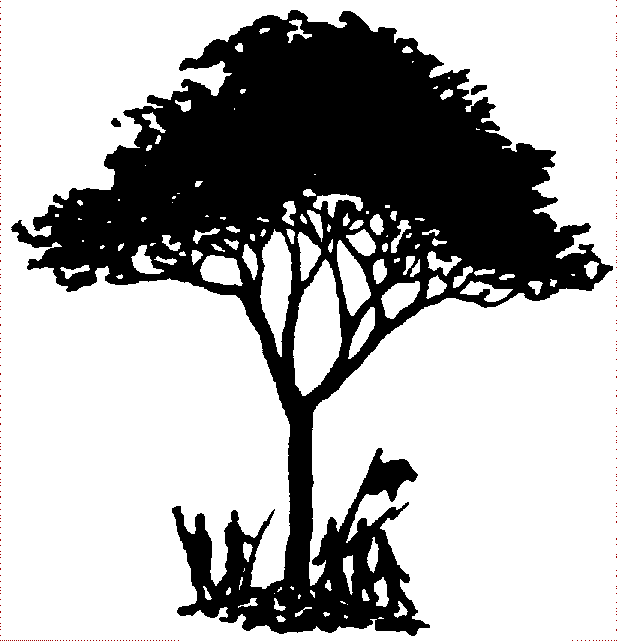
It was August, 1765 when a crowd gathered at Hanover Square, Boston, Massachusetts Colony to view the effigy of Andrew Oliver hanging from a tree which would soon become known as the Liberty Tree. Oliver, a wealthy merchant, had taken a position as Distributor of Stamps for the Crown, King George III. The crowd then moved down to a wharf owned by Oliver and tore down a building that was under construction. They then proceeded to Oliver"s house and threw rocks through the windows, tore down the garden fence, took fruit from his trees and then broke into his house looking for Oliver . They were stopped from completing this deed when a justice and the sheriff arrived. The crowd dispersed, but not until hurling bricks at the justice and the sheriff.
The next day a delegation presented itself to Oliver and demanded that he resign his position, or his house would be destroyed and his life in danger. Oliver resigned and the Sons of Liberty were born.
Thomas Hutchinson, the justice who had come to Oliver"s rescue didn"t fair so well. When he refused to step down from his position, his house was nearly destroyed, his property stolen and he barely escaped with his life. Many other Tories began to feel the wrath of the colonists, tired of the yoke of oppression imposed by King George.
Sons of Liberty organizations began springing up all through the colonies. The British referred to them as "Son of Violence" because of their aggressive, and frequently deadly, behavior. Among numerous reports were one of a man being tarred and feathered for toasting the King"s health. Effigies were frequently burned, often with the carriage of the object. Houses might be burned down with no regard for the safety of those inside.
These actions by the Sons of Liberty probably eventually resulted in the removal of most of the items being taxed by the Act. Tea, however, was not one of those items removed from taxation. The Crown would not submit completely to the violence being waged against his agents.
In March 5, 1770, a shouting match between British troops and angry colonists, mostly young men, evolved into a near riot. Although the officer in charge of the troops expressed his desire not to fire upon the colonists, a voice from somewhere behind the troops yelled "fire", which the troops did. The officer then called for a cease fire and reprimanded his troops, but five were killed and seven wounded, two mortally. This event would become known as the Boston Massacre. The soldiers were put on trial for murder. Defended by John Adams and Josiah Quincy (who withstood the wrath of angry crowds in the name of justice) all but two were acquitted. Those two soldiers were found guilty of manslaughter, sentenced to death, sought sanctity of the Church, had their thumbs branded and were returned to their regiment.
Three years later, on December 16, 1773, a small group of men dressed as Mohawk Indians were followed by a crowd to the wharf in Boston. They boarded the ships Dartmouth, Eleanor and Beaver and began dumping all of the tea on board, 35,000 pounds, into the harbor. This, of course, was the Boston Tea Party.
Looking at the circumstances that surrounded the events beginning in 1765 and culminating with the battle on April 19, 1775 at Lexington and Concord, the Sons of Liberty conducted random acts of violence against the oppressor, and his agents. Their targets were selected for the actions that they participated in. Although trials were not held, there was little doubt as to the guilt of those subjected to the acts of the Sons. Their targets could be equitable with the likes of Lon Horiuchi, Jeff Jamar, judges Walter Smith and Robert Harper. Surprisingly, the retaliation which might have been anticipated then was not forthcoming. These escalation of events occurred over ten years before the beginning of the Revolutionary War. The justice served by the Sons of Liberty was a relief, at least to some degree, to the oppression of the British. The reaction of the populace was not one of rejecting the Sons, but rather the calm acceptance of the circumstances that justice imposed. Rather than stand idly by and allow the oppressors to take whatever advantage they chose, the colonists retaliated against nearly every enactment, act or abuse directed at them.
The Sons of Liberty were the spirit that manifested itself into the Continental Army which led the fledgling nation to victory against the greatest military force the world had ever known.
Is that spirit still alive today?
Return to Sons of Liberty Index
Go to Next Sons of Liberty