Outpost of Freedom
June 1, 1995
What really happened in OKC? #4
The key to acceptance of what really happened in Oklahoma City probably lies in whether the homemade bomb could have caused as much damage as it did, or not. If it could not have, then any one of the other current versions of what happened could be true. If, however, a homemade ammonium nitrate bomb could have caused the damage that is apparent in OKC, then consideration must be given to the possibility that over zealous patriots may have been the only source and cause of the events of April 19, 1995.
First, many have said that it could not have been an ammonium nitrate bomb because there was no black smoke, etc. The fuel oil that would have been used in the bomb, if burned under lower heat and pressure conditions, would have emitted large amounts of highly carbonic (black) smoke, just as diesel engines do. On the other hand, if the fuel oil is ignited under ideal conditions of both pressure and heat, the complex chain of carbons can be broken down. Under these conditions even more power is generated. What comes out under other circumstances as black smoke, when fully consumed, is generated into energy rather than smoke.
The ammonium nitrate works as an oxidizer. One of the problems in normal combustion is a lack of sufficient oxygen in the burning process. By providing an "internal" source, the combustion is much more thorough. The other factors, heat and pressure, that would epitomize the combustion would be provided by the ignition source. Even dynamite might provide the force necessary to cause the complete burning, especially if the ammonium nitrate was extremely dry when the mixture with the fuel oil was made. Ammonium nitrate has a tendency to absorb moisture out of the air. If the ammonium nitrate were ground in extremely dry circumstances and then mixed with the fuel oil, the mix would be that much more volatile.
Suffice it to say that three sources I have contacted all agree that the Ryder truck, two thousand pounds of ammonium nitrate fertilizer, fuel oil and the proper preparation and ignition could easily have provided the force necessary to cause the damage to the building that was necessary to have the effect that we have seen.
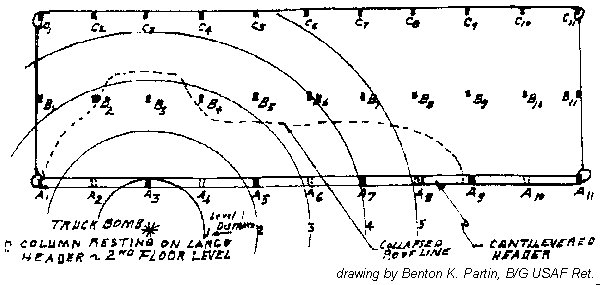
There are two other factors that will be considered here. First is the force of the bomb, as measured to determine the size necessary. Benton K. Partin, USAF Ret., provided a formula in a narrative he put out about the bombing. He calculated, however, an extremely large bomb as a result of some erroneous assumptions he made. When I used his formula to calculate the size of the bomb, it came out to about four thousand pounds Anybody interested in his report may contact me, and I will provide a copy. To avoid going into detail, however, I will explain, briefly, the erroneous aspects of his conclusions. First, he used a crater with a depth of twenty-five feet. When I substituted 10 feet (some reports are eight feet in depth) I came up with the much smaller bomb size requirement. Second, he suggests that the damage to the building was all from the bomb. I will discuss this more in just a moment, but he uses the distance of eighty feet (to the top of the damaged portion of the building). If I were to substitute the distance to the damaged wall which resulted in the buildings collapse, I would probably be looking at 15 to 25 feet. This, again, would result in a complete reevaluation in the size of the bomb. To explain why the 80 feet is not appropriate for the calculations, I will use a drawing that Mr. Partin had included in his report. The drawing shows three rows of eleven columns. Ever other column is indicated to be larger than the intermediate ones, which is very consistent with design practices. The corner columns are even more substantial. He has identified the rows as 4 B & C, from front to rear, and the columns are numbered 1 through 11, left to right. The notes are Mr. Partin"s, as well.
The bomb was set off, as shown, in front of column A-3. It is necessary to understand a bit more about the building to realize exactly what happened. Early reports indicted that the bottom three floors of the building were the rigid portion, and the remainder was the flexible portion. Buildings are generally designed in this manner. The base is rigid to provide a substantial "foundation" for the upper portion. The upper portion is made "flexible" to provide for sway in the event of strong winds, earthquakes, etc.
Now, consider the bomb blast"s force knocked out the vertical column at A-3. The horizontal beams between A-3 and 8-3, A-3 and A-2, and those running from A-3 to A-9 are also impacted by the force of the blast. The loss of vertical support at A-3 and subsequent weakening of the entire rigid portion at the other lines indicated above, causes a failure in the foundation of the building. As a result of this failure, the flexible portions of the building that relied upon the integrity of these portions would become unsupported, at least to the degree that failure would be probable, barring any outside factors.
Inside of the building were interior support columns which are more frequent than the primary columns shown. So long as the integrity of those columns was unaffected, they might be able to maintain the load on them from the doors above. Those that relied completely on the failed columns had no where to go but down.
In viewing the damage, note that the damage to the floors of each of the nine stories is a carbon copy of the floor below. This would indicate that the damage was actually a result of the building collapsing upon itself, rather than all of the damage being a direct result of the bomb. The damage line is shown on the drawing, and is true for every door. If the damage on the upper levels were a direct result of the blast, this line of damage would be very irregular, and indicative of the force of the blast as it impacted each portion of the building. It appears, then, that the majority of the damage is a result of the building"s failure instead of a direct result of the bomb.
This leads to another conclusion. I believe that McVeigh, or whomever committed this "act of war" did not expect the damage to be what it was. As was evidenced by certain statements made, this sight was selected because of the large number of windows in the front, and the closeness to the road. It would appear, then, that it was intended that the blast would break windows, and create havoc. I"m sure that the bombers were somewhat surprised when the extent of damage was finally realized.
Return to Oklahoma City Index